
A key engagement of the Waterloo campaign, fought for control of the crossroads linking the Allied armies.
After the rapid French advance of the previous day, the strategic crossroads at Quatre Bras became crucial, as they linked the current Allied positions. Blücher planned to stand at Ligny believing that his right flank would be reinforced by Wellington’s troops advancing from Quatre Bras.
Once Napoleon realised that the Prussian army was prepared to offer battle, he conceived a plan to pin Blücher’s troops until reinforcements could arrive through the same road and help destroy the Prussian army, which was his immediate objective.
As the battle of Ligny developed, Wellington hastened his troops forward and Napoleon urged Ney to attack. At 14:00 Ney finally launched the assault on Quatre Bras. The battle for control of the crossroads then began, while both sides struggled to bring up reinforcements in time.
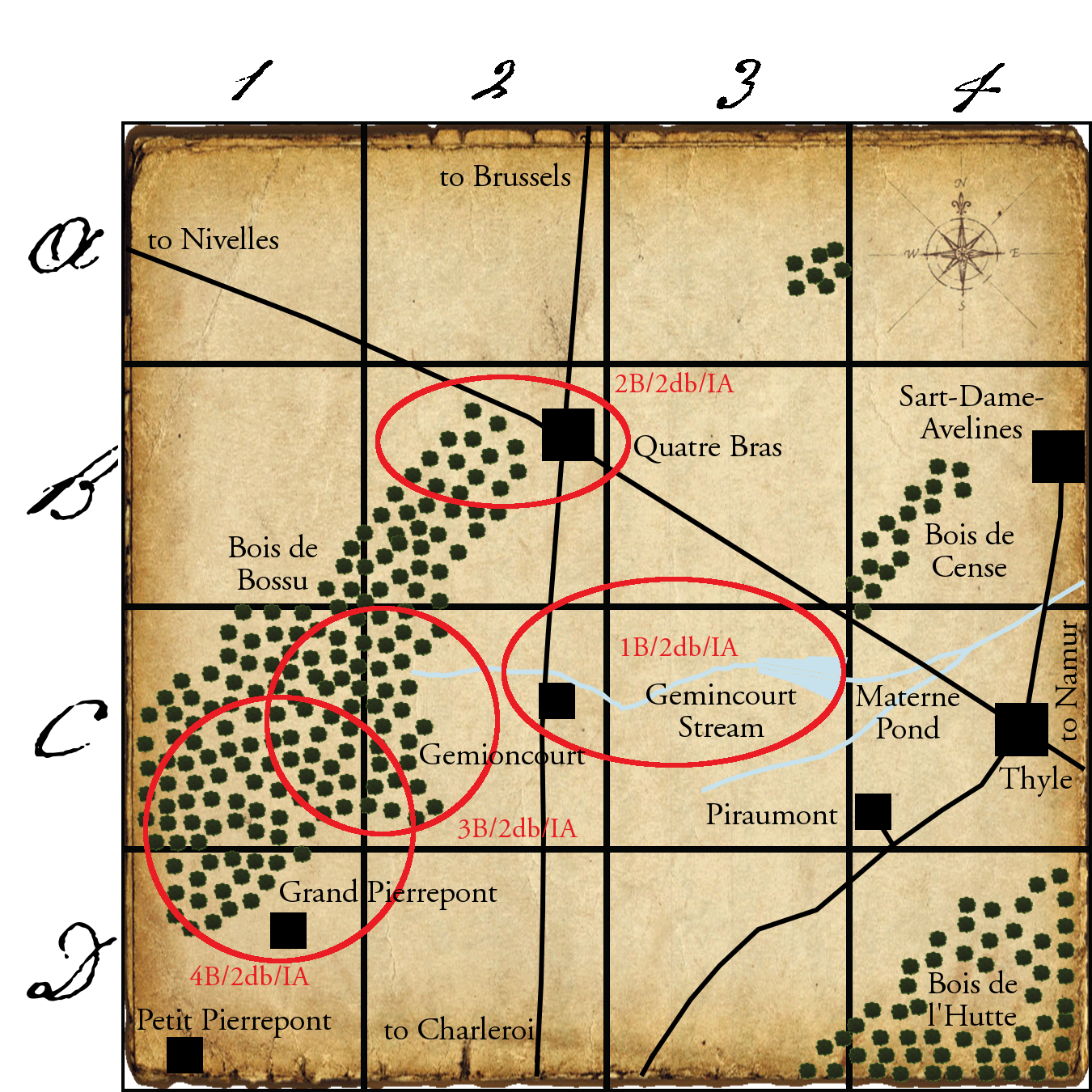
Quatre Bras, Thyle and Sart-Dame-Avelines have a +2 combat modifier.
Petit Pierrepont, Grand Pierrepont, Gemincourt and Piraumont have a +1 combat modifier.
The pond may not be entered by any units.
The Allied on-table forces are set up first.
If desired, one base of 1B/2db/IA may start detached at Piraumont.
Petit Pierrepont, Grand Pierrepont, Gemincourt and Piraumont are small BUAs (1.5" x 1.5"), and a maximum of 2 infantry bases and 1 artillery battery may be deployed in each.
Cavalry or artillery units that are in any portion of the Gemincourt Stream between Materne Pond and Gemincourt for any part of their movement are immediately disordered.
The Bois de Bossu is considered an open wood area.
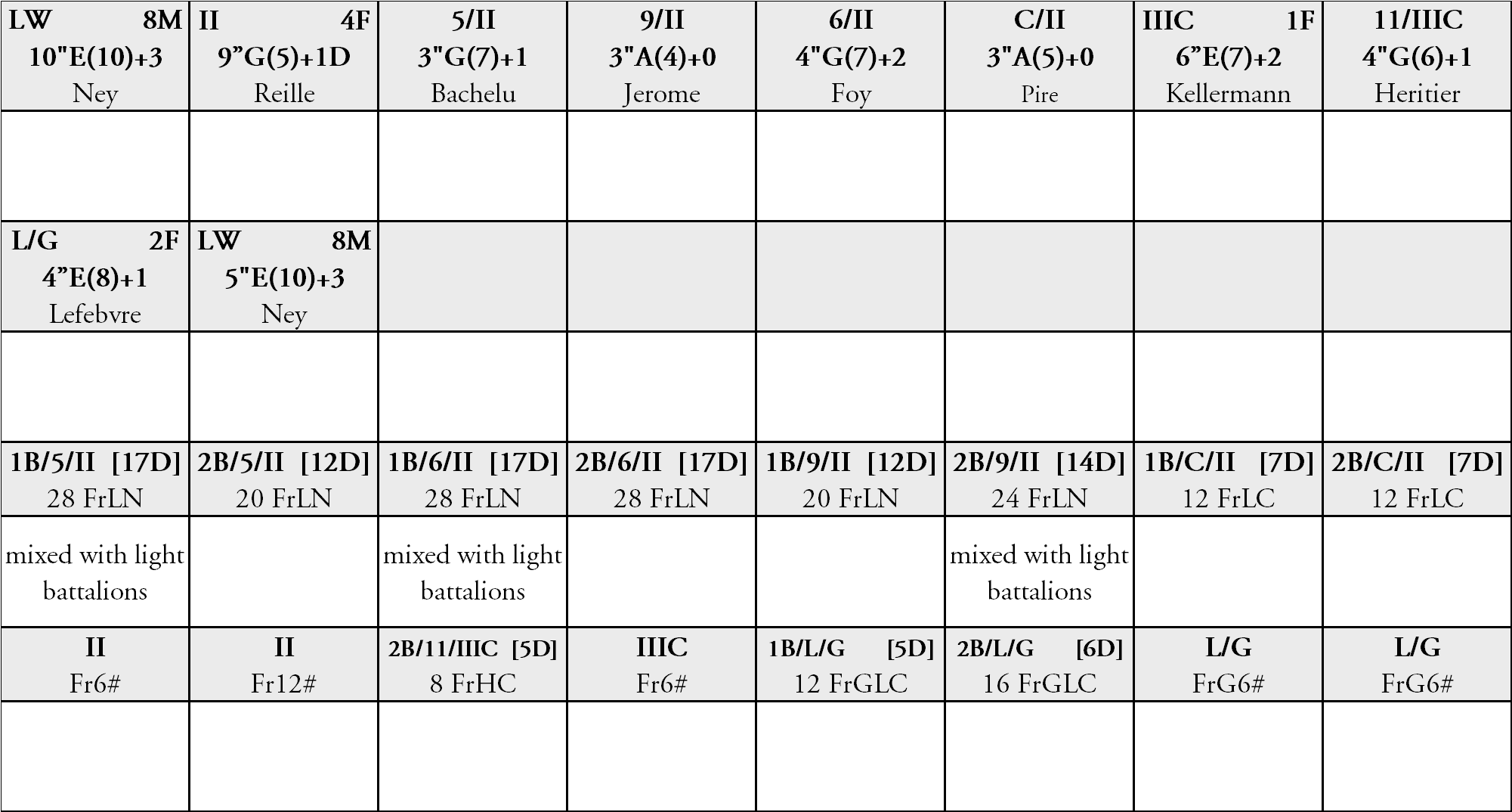
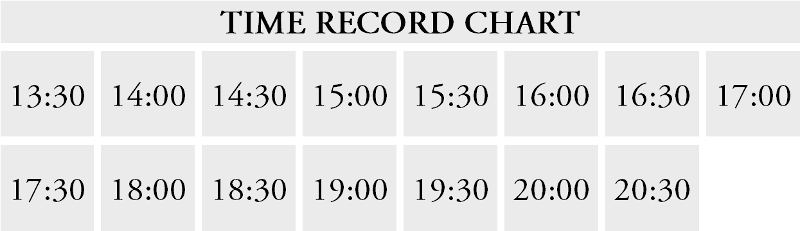
13:30 to 20:30.
The French are the first side.
The French start with the initiative marker.
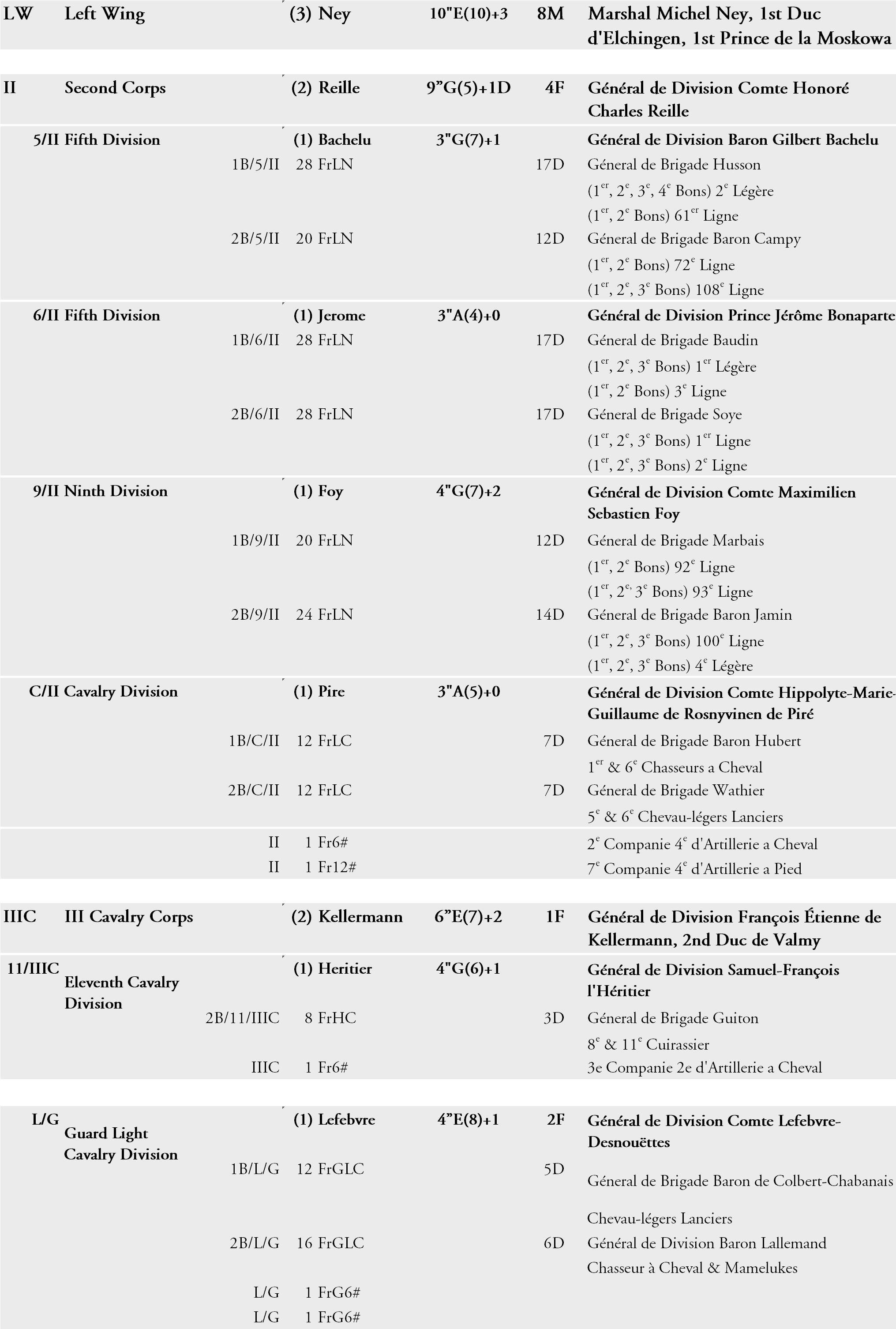
13:30 – Ney, Reille, 5/II, 9/II, C/II and artillery batteries from II Corps, deployed in any desired formation and facing, at D2 and D3.
14:00 – 6/II in march column formation on D2 road end.
14:30 – IIIC deployed at D2 and D3.
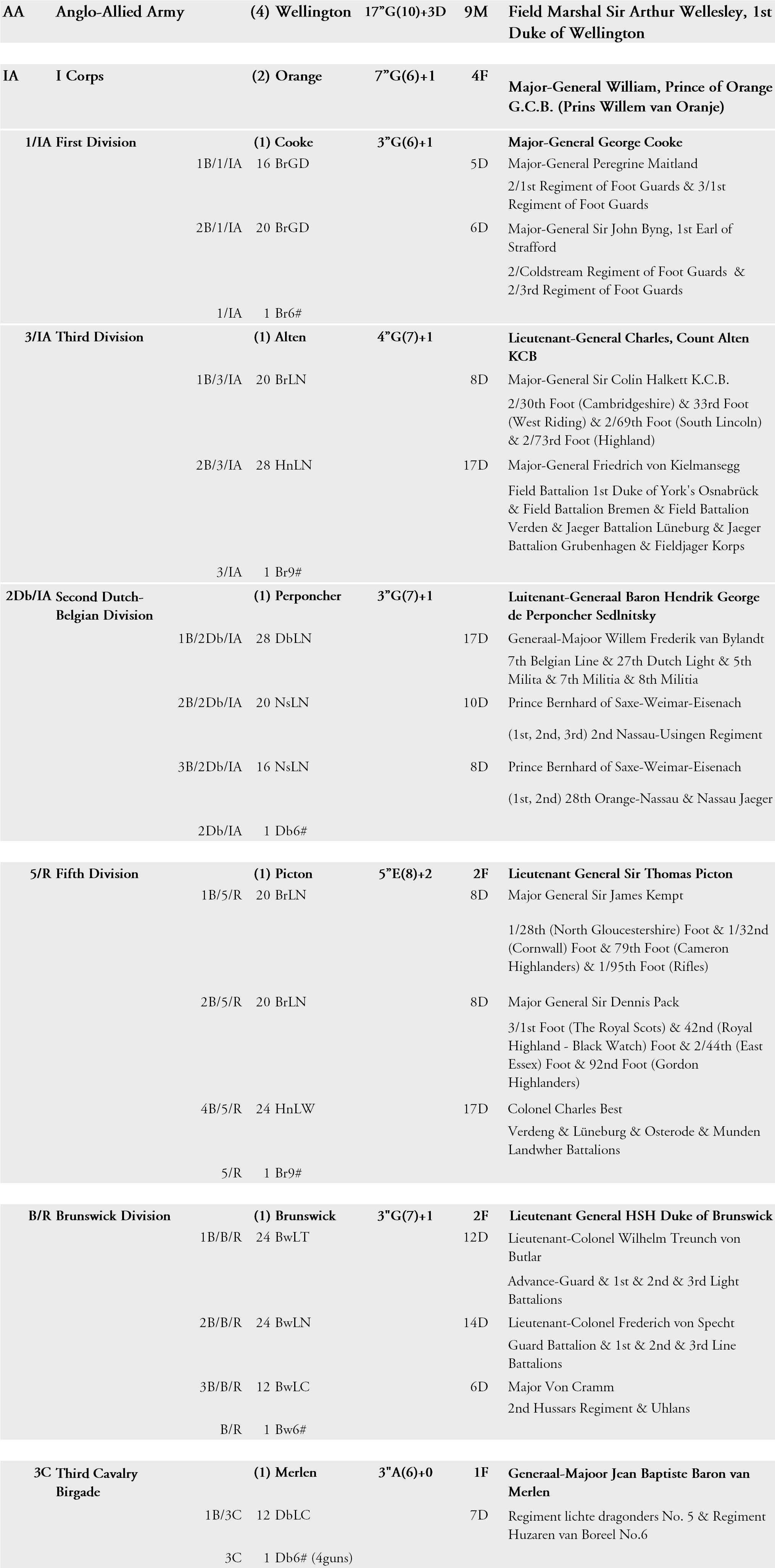
14:00 – 3C in march column formation on A1 road end.
14:30 – 5/R in march column formation on A2 road end.
15:00 – Wellington and B/R (less B/R artillery) in march column formation on A2 road end.
16:00 – 3/IA in march column formation on A1 road end.
18:00 – 1/IA in march column formation on A1 road end.
18:30 – B/R artillery in march column formation on A2 road end.
Due to the arrival of reinforcements, the army morale of both armies increases as the day progresses. Check the following table to find the Army Morale at any time.
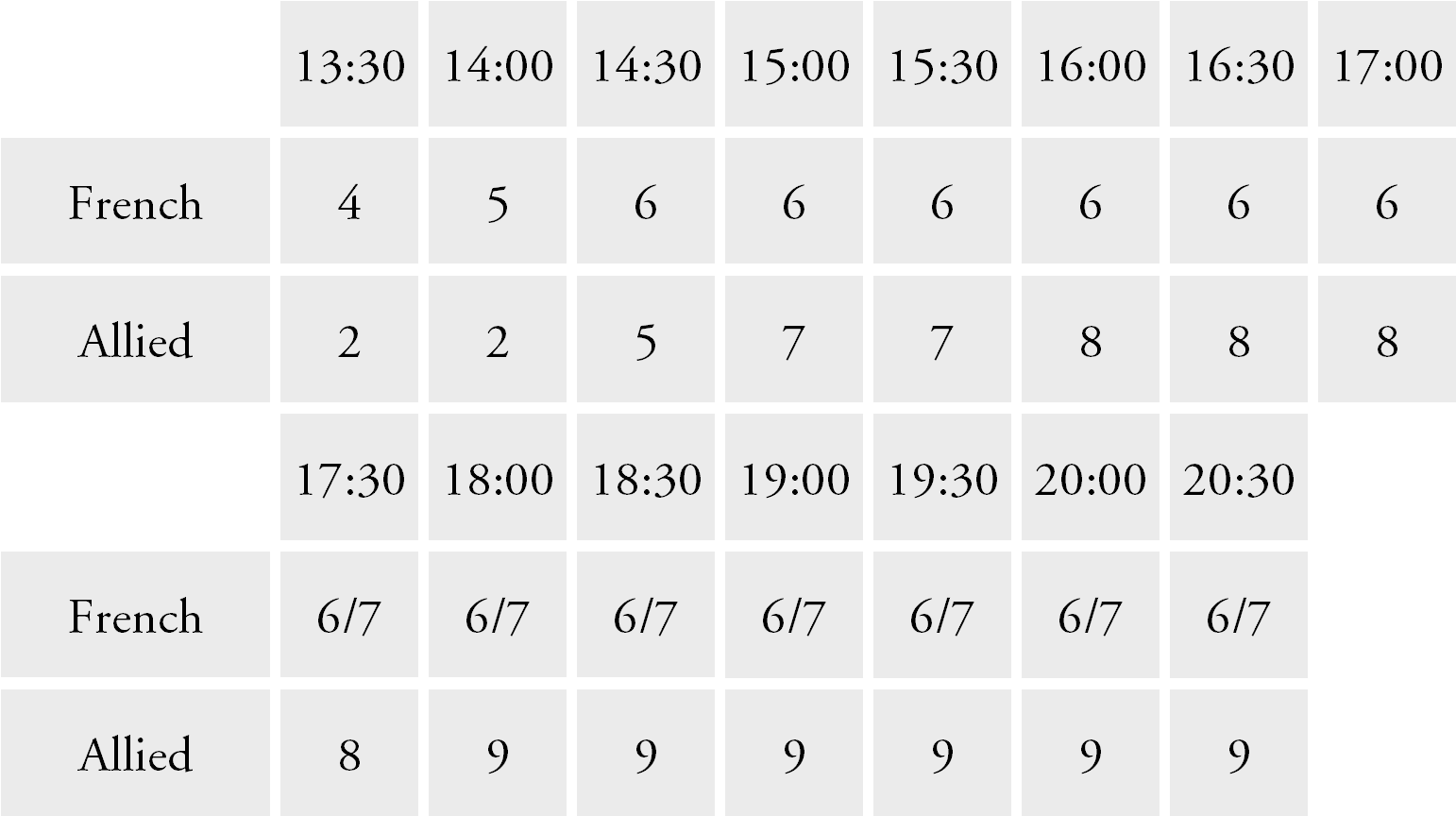
The fatigue of II Corps and IA also varies due to reinforcements.
At 13:30 the fatigue of II is 3F instead of 4F, but once 6/II arrives at 14:00 it becomes 4F for the rest of the game.
The fatigue of IA is 2F at 13:30, rises to 3F at 16:00, and becomes 4F at 18:00.
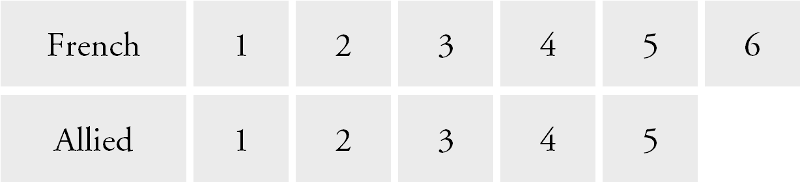
The French get 5 free rolls and the Allies get 5.
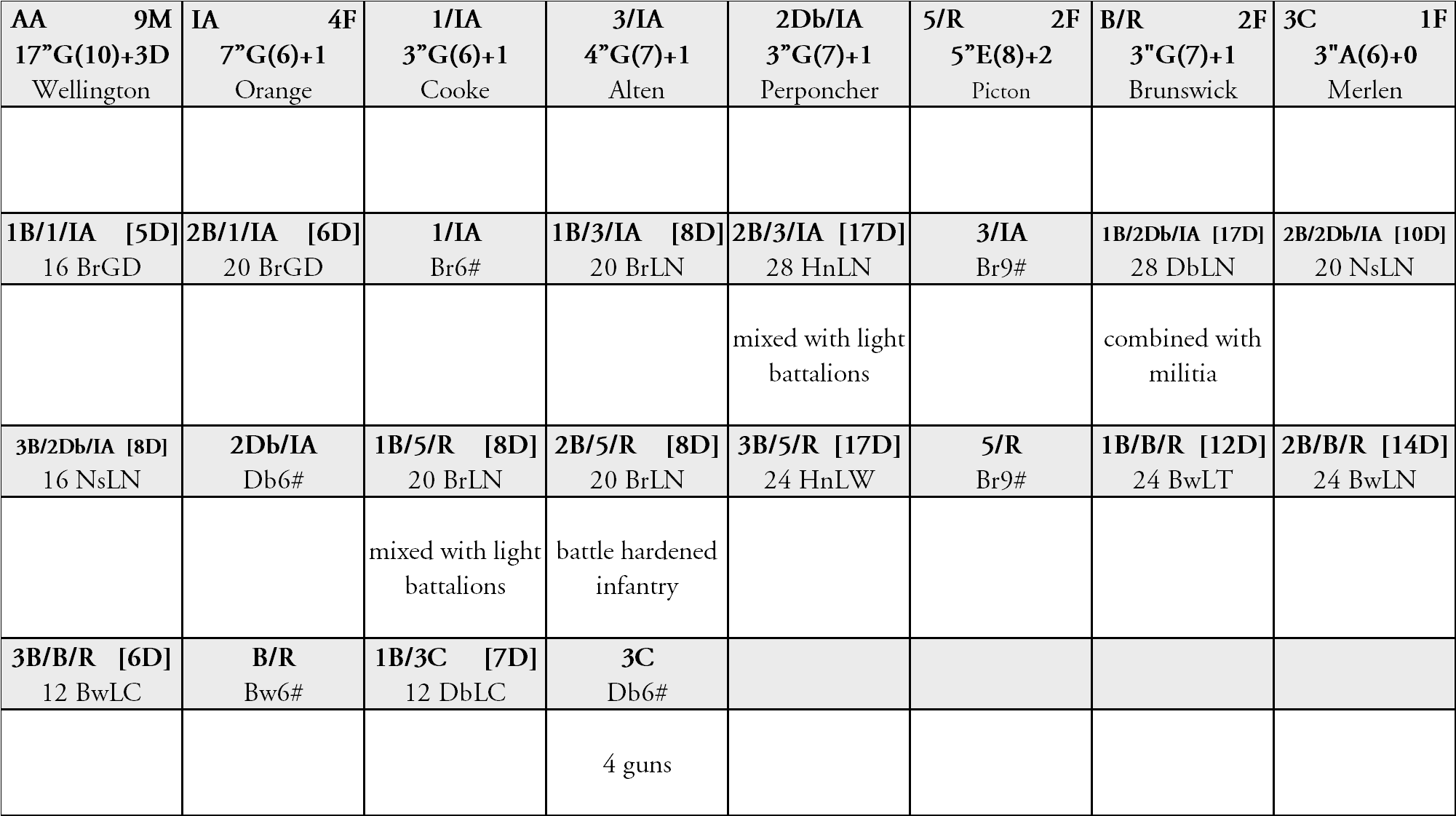
1B/5/II – mixed with light battalions.
1B/6/II – mixed with light battalions.
2B/9/II – mixed with light battalions.
2B/3/IA – mixed with light battalions.
1B/2Db/IA – combined with militia.
1B/5/R – mixed with light battalions.
2B/5/R – battle hardened infantry.
As Marshal Ney had only recently received his command, he lacked a proper staff and aide-de-camps. To represent this, Ney’s span is reduced to 5 inches instead of 10 inches. Victory points should be adjusted accordingly, and the French player adds 5 points to his final victory total.
Although Ney had been given command of the Guard Light Cavalry, he was forbidden to use them by the Emperor. As Allied reinforcements continued to arrive and d’Erlon’s I Corps failed to appear, Ney might have been tempted to commit them. To represent this, the G/L may arrive as reinforcement after 17:00, if desired by the French player.
If this option is used, any casualty suffered by the L/G counts as three times its normal victory point value, and the objective values become:
Until Wellington arrives, the Prince of Orange may be treated as the overall commander for the Allied army, using a 10 response instead of 6. Once Wellington arrives, the Prince of Orange uses his normal response.
This battalion was left in the rearguard until late in the evening and historically arrived at 18:30. To reflect this, an alternative version of the 1/B/R label may be used.
If this option is chosen, the Allied player begins with the alternative label (20 BwLT instead of 24 BwLT) until 19:00. At that time, the normal label is restored and one four-figure base is added to the existing 1/B/R force during the Arrival Step. If the unit has already been dispersed, surrendered or has left the map, the reinforcement is lost.
Quatre Bras – 45/64 Allied/French
Gemincourt – 15/21 Allied/French
Grand Pierrepont – 5/7 Allied/French
Thyle – 20/29 Allied/French
After a rapid start to the campaign on the 15th, the French arrived with the last light of day in front of Quatre Bras. The Prussian retreat to Sombreffe left the road to Brussels unprotected. Only a few Belgian and Dutch troops, who had expected support from their Prussian allies, now defended the crucial crossroads.
Fortunately for the Allies, General Constant Rebecque understood the importance of Quatre Bras and chose to ignore his orders to withdraw to Nivelles. Instead, he held his ground with the Dutch-Belgian troops and called for reinforcements.
On the 16th Ney, who had only taken command of the left wing the previous day, failed to fully concentrate his forces during the morning. Meanwhile the Allies finally reacted and ordered reinforcements to march urgently to the crossroads.
At 14:00 Ney launched his assault to seize the crossroads and threaten the Prussian flank at Ligny. Ney initially enjoyed numerical superiority and pushed the Belgian-Dutch troops back towards the crossroads, but Picton’s division arrived just in time and prevented collapse.
As the afternoon wore on, the steady arrival of Allied reinforcements gradually turned the tide. Ney received repeated orders urging him to march to Ligny, but he was unable to disengage and was not reinforced by d’Erlon’s I Corps, which marched and counter-marched without joining either battle.
By the end of the day, despite French elan and several gallant cavalry charges, the French had withdrawn to their original positions. Casualties on both sides ranged between 4,000 and 5,000, yet neither side achieved its primary goal. The French failure at Quatre Bras proved decisive, as it deprived Napoleon of the crushing victory he sought at Ligny.
You can also download the complete Quatre Bras scenario in PDF format.
Download PDF